I let AI run a media business in Manila for four months
In June I started What's On Manila as an experiment to see how much of a small media business AI could run on its own. In the thirty days to 28 September its Instagram page was viewed just over a million times. The agents did almost all of the work, and almost none of the growth came from the agents.
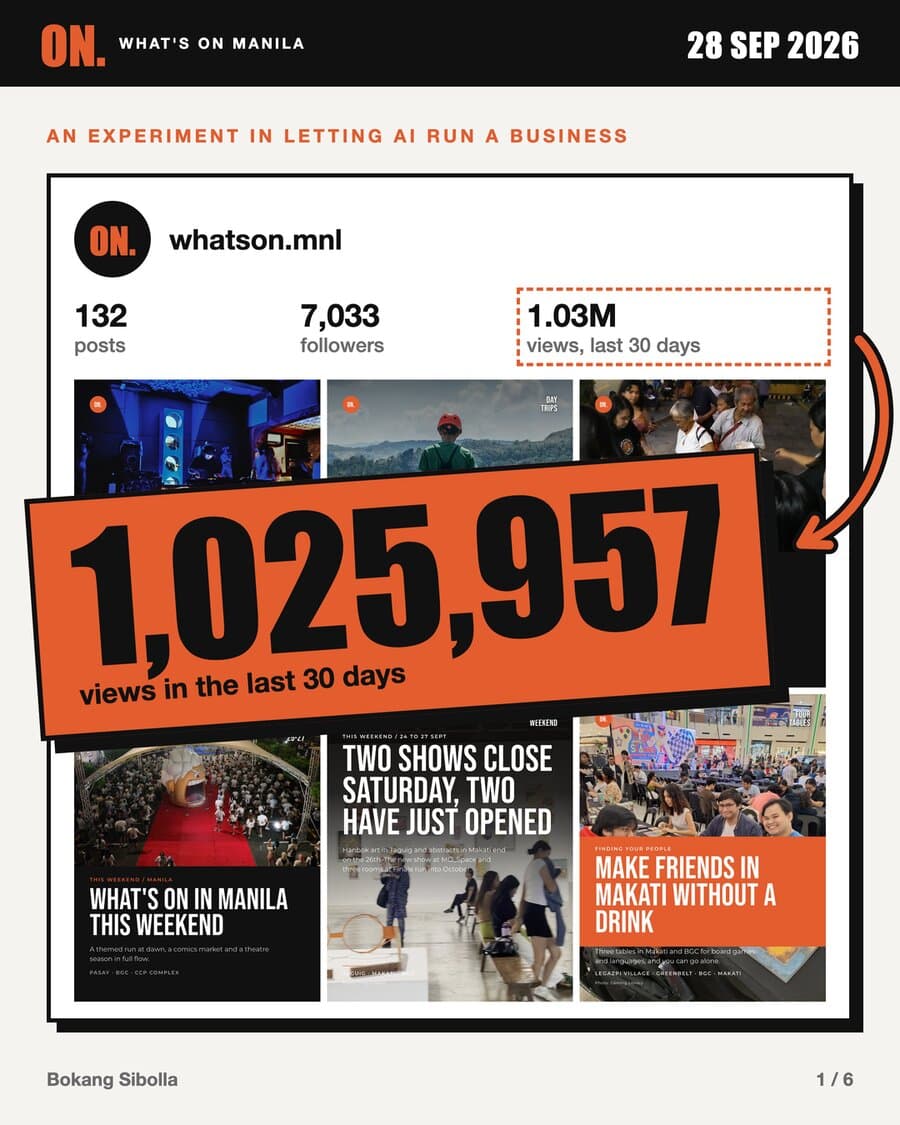
In the thirty days to 28 September, the Instagram page for What's On Manila was viewed 1,025,957 times. In its first thirty days, from the end of May, it was viewed 117,465 times, and for the two months after that it barely moved. The page is a guide to things to do in Manila, run from start to finish by AI agents I built, and the million is the number people ask me about. The more interesting number sits underneath it, which is how little of that million the agents were responsible for in the way people assume.
I started it as an experiment. I had been curious for a while whether a small media business could run itself, with software doing the research, the writing, the design and the publishing, and a person doing only the part that needs a person. What's On Manila was the cheapest honest test I could think of, because I needed it myself.
The gap was people like me
When I moved to Manila I kept struggling to find out what was on. A gallery opening, a run club, a talk, a café where you could work for a whole afternoon without being made to feel you had overstayed, all of it existed, but the information lived in scattered Facebook events, group chats and venue pages, and half of it was out of date by the time you found it. There were already plenty of pages covering the city, mostly built around concerts, promotions and whatever a venue was paying to push that week.
What I could not find was something written for a person who had just arrived, or had been here a year and still did not know where anything was. So that became the brief. I wrote for people who have moved to the city for work or for a new start, and for anyone still finding their way around, and I kept to the parts of the city those people actually live in and can reach on a weeknight, Makati, BGC, Rockwell, Salcedo, Legazpi and Poblacion, with things to do in and around them rather than everything in Metro Manila. When Instagram first reported the audience in early September, the largest share was in Makati, then Quezon City, then Taguig, which was close enough to the brief to keep going.
What the agents actually do
By 10 June the publishing was automated. A queue in a database holds each post with its images, caption and time, and a scheduled job publishes it to Instagram without my phone being involved. Around that, over the following months, grew the rest of the system. Research agents search for what is on across the city and write each item up with its source. Other agents draft the posts, a renderer lays out the slides, and another set keeps the website current, so that events expire when they end and new ones appear with their own pages that Google can find. A separate agent reads the Instagram messages, sorts them, and emails me when someone needs a decision.
The page now publishes twice a day. On most days my part is reading what is queued and saying no to some of it.
It would be dishonest to call it autonomous and leave it there, because the system only got good by failing in front of an audience.
It failed in ordinary, embarrassing ways
The first posts looked like everyone else's. They were plain white cards with an event name, a photograph and a date, correct and forgettable, and for three months the numbers said so.
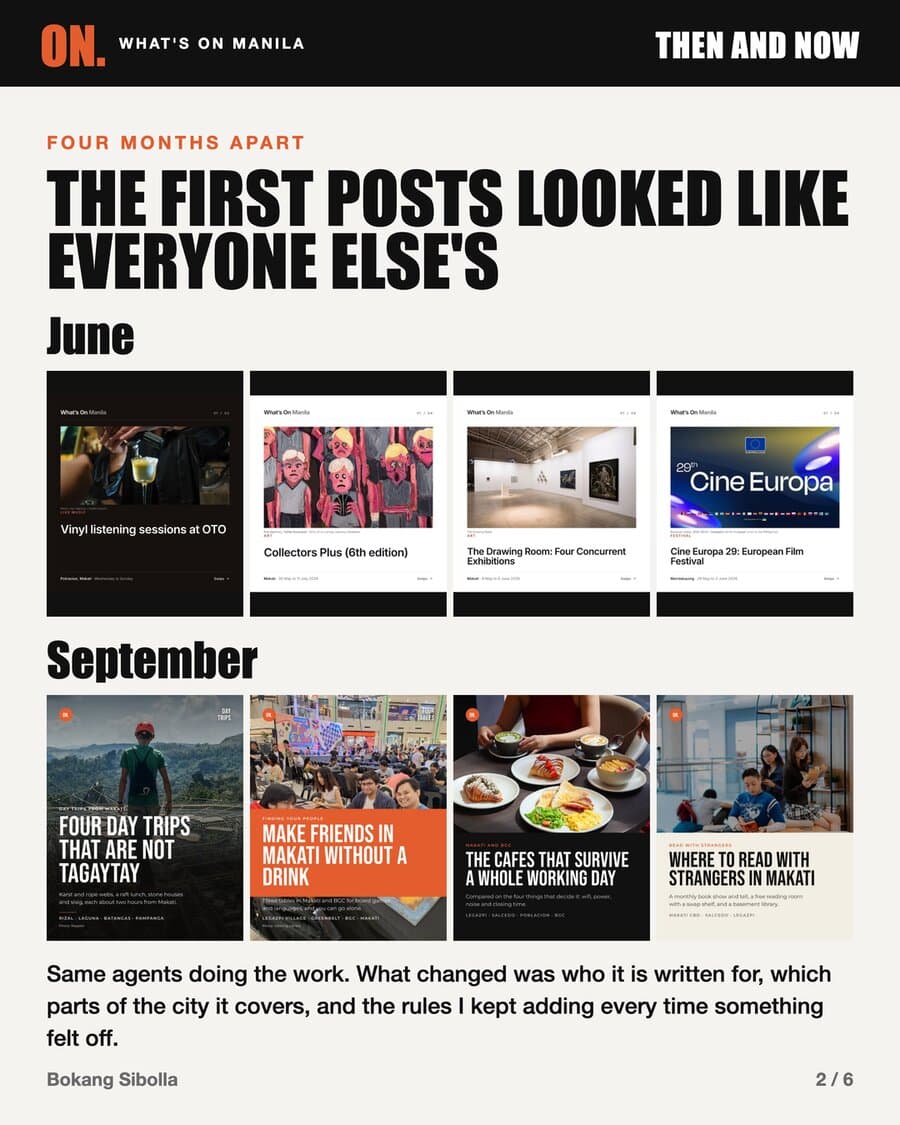
The agents also repeated themselves. Two separate builders picked from the same table with the same ranking and neither knew what the other had chosen, so in one week ten items appeared twice across nine scheduled pieces, and the same weekend market kept turning up as if Manila only had one. The accuracy was worse than the repetition. A simple rule that looked for the word "free" labelled a Michelin-listed afternoon tea as free entry, because its listing offered free-flow tea, and a natural wine bar got the same treatment. On 18 August five carousels went out with their text cut off at the bottom of the slide, one of them ending mid-sentence on the words "Come at", and the renderer had reported every one of those slides as fine, because nothing in the system was actually looking at the picture.
The failure I think about most was the quietest. The weekly newsletter, which I had decided was the real asset, stopped sending on 17 July. The job that wrote each Friday's edition kept running, so seven finished drafts piled up unsent over seven weeks, and nothing told me, because I had built a thing that checked whether the work was done and never whether it had arrived.
Every complaint became a rule
What changed things was deciding to treat each of my complaints as something to build rather than something to fix once. When I said the page kept recommending the obvious places, the system got a ledger of everything it had already featured, read from the files it had actually published, and a check that refuses a repeat. When I said too much of the information was wrong, every fact on a slide had to carry a quote from a source that says it, and a second agent now goes back to those sources before the post goes out and holds it if a venue has changed its hours or its price. After the slides with missing words, a check started reading the rendered image and failing anything where type touched the edge. When I said the crops kept cutting through people's faces, the system learned to find the faces in a photograph before laying out a slide and to show the whole picture on a black mat rather than trimming it.
None of this is sophisticated. Each rule is small, most of them are a few dozen lines, and some of them exist because a single post embarrassed me. The point is that they are enforced by code that the agents cannot talk their way around, instead of written in a prompt and hoped for, and that past mistakes are kept as tests that must keep failing.
The growth came from judgement, and I had to measure it
The other half was deciding what the page is for, and there the agents were no help at all, because they were happy to write about anything.
In August I pulled the numbers for forty-five published posts and grouped them by the kind of thing they recommended. Posts about things that are free, recurring and easy to turn up to, a run club, a volunteering morning, a book club with a table for strangers, were shared by people who saw them at a rate of 28.9 percent. Only three posts sat in that group at the time, which is a thin base for a rule, but everything since has pointed the same way. Posts about things you pay to get into were shared at 0.9 percent, and concerts did worse still. Sharing is the signal Instagram uses to decide whether to show a post to people who do not follow you, so that one gap decides almost everything. The best post the page has made, about run clubs, was shared by more than six in ten people who saw it. A post on 28 August about where to volunteer in Manila reached 14,500 people and brought in 388 followers on its own, and it was never boosted.
That finding matched what I had noticed as someone new here, which is that the hardest thing to find in a new city is a way to be around people without it costing a cover charge and a reason. The agents had the data the whole time. Deciding that the page should be about finding your people rather than what is on sale this weekend, and then holding to it when a paid event looked more exciting, was the part only I could do. So was the writing brief: plain English that works for someone reading in a second language, never naming the audience as a class of person, and always saying which part of the city something is in, because in Manila traffic that decides whether you go.
I have spent more than a decade in digital, running paid media and watching what people actually save and share, and I leaned on all of it. I also got some of it wrong. Early on I bought followers with ads, and one campaign optimised for link clicks bought 932 clicks and only 213 follows, which taught me that Instagram will sell you exactly the outcome you ask for, whether or not it is the one you wanted.
What happened after that
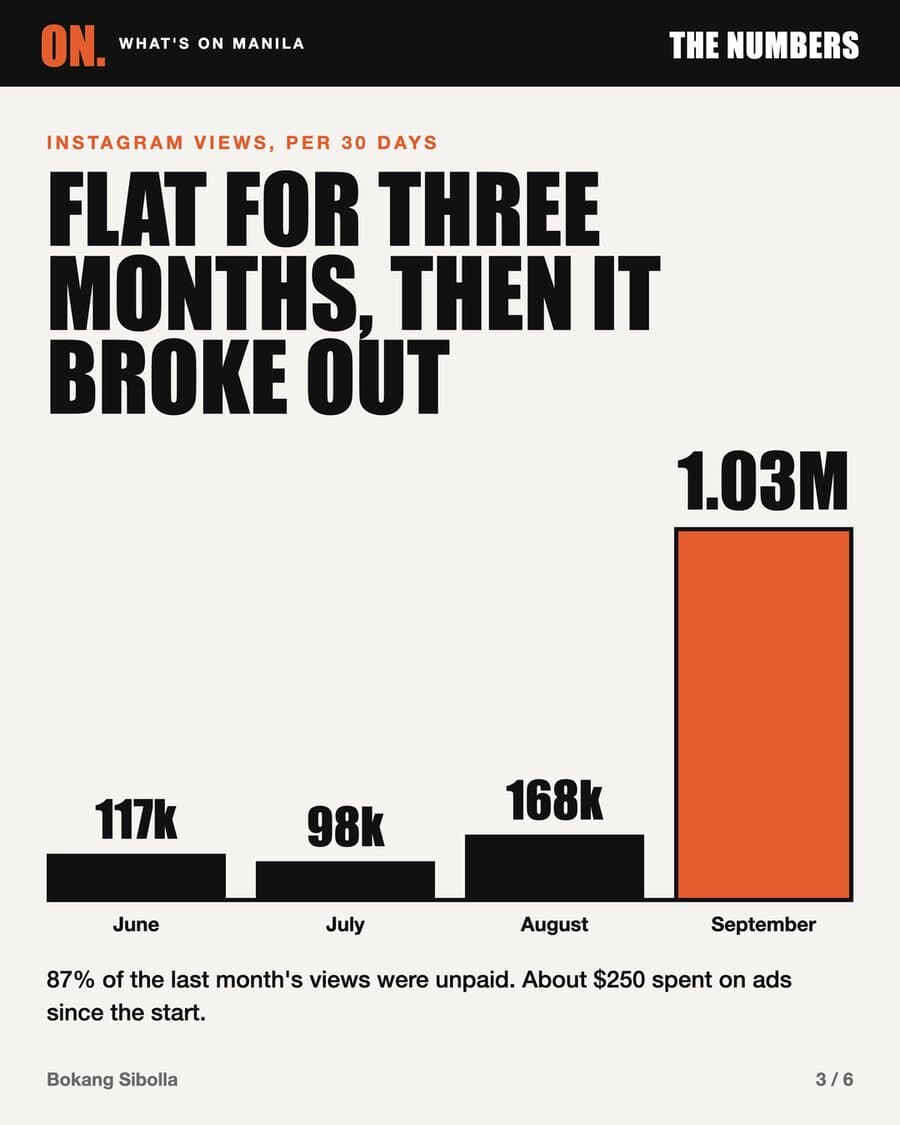
Views went from 117,465 in the first thirty days to 98,163 and 168,472 in the next two, and then to 1,025,957 in the thirty days to 28 September. The page has 7,033 followers, up from about 200 in early June.
The honest version of these numbers is messier than the headline. Some of those followers were paid for, because I ran follower ads through the middle of September at roughly three and a half pesos a follow. Ads also delivered 133,347 of the impressions in the last thirty days, so about 87 percent of the million was unpaid, and the total I have spent on ads since May is ₱14,593, about 250 US dollars. I would rather say that plainly than have someone work it out for me.
The website tells a quieter story that I find more encouraging, because nobody can buy it. In the three months to early September, pages on the site sat at or near the top of Google for searches like upcoming concerts in Manila in 2026, and in the top few results for theatre shows in Manila. Visitors sent by ChatGPT went from 30 in July to 134 in August and 320 in September, which means that when someone asks an AI assistant what to do in Manila, it increasingly points them to a page my agents wrote.
The messages changed too. Since the message-reading agent started on 17 September, ten separate venues, brands and organisers have written to ask to be featured or to partner, among them a gallery wanting its shows listed, an optician wanting a feature, and an organiser asking what it would cost to promote their event. I never pitched any of them, and each one found the page on its own.
The loop is still open
None of that is revenue yet. The revenue is still zero, and every one of those ten messages is currently sitting with me, because the system stops at the point where someone offers money and I have to decide what to say.
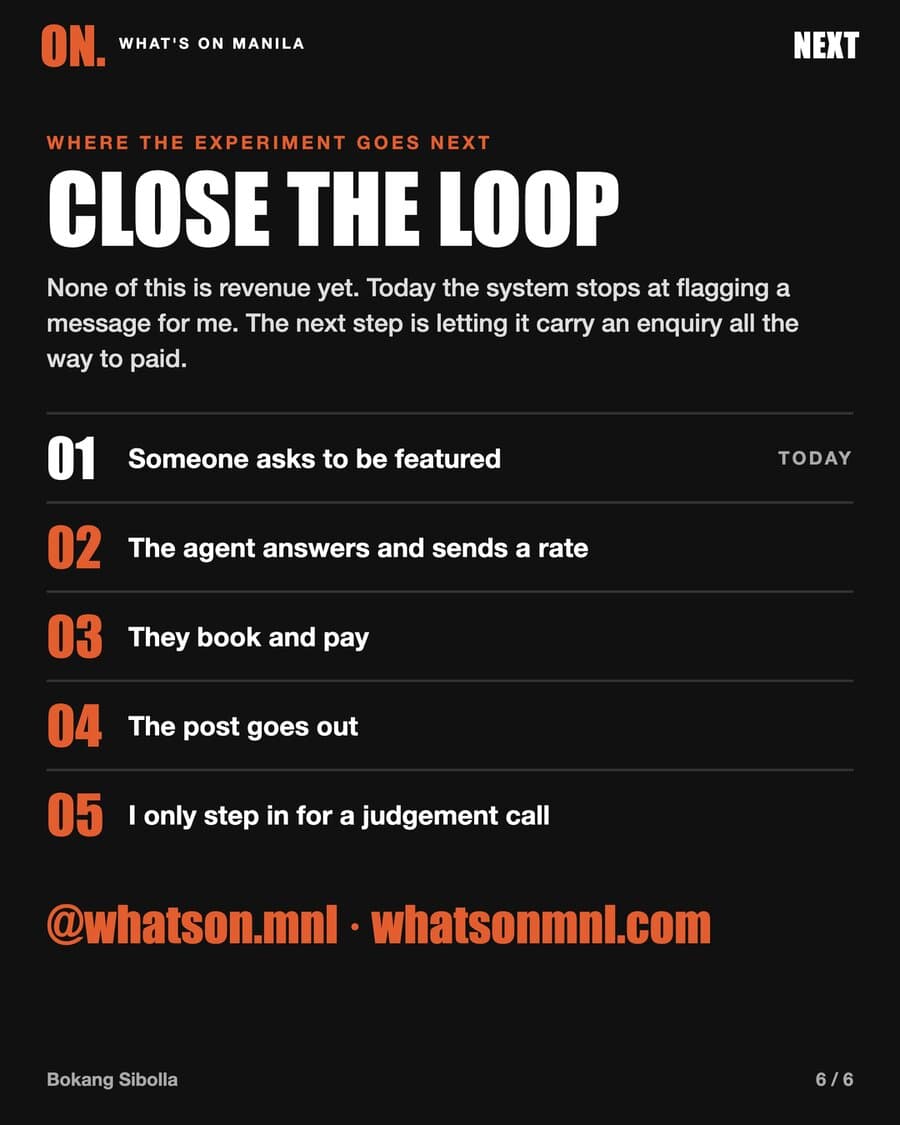
That is the next part of the experiment. I want the same system to take an enquiry all the way to paid: answer the message, send a rate, take the booking and the payment, schedule the post and check it went out, with me stepping in only when something needs a judgement call, like whether a venue fits the page at all. Every rule I have written so far points at that, because a business that runs itself is only real once it can collect money without me in the middle, and it has to do so without selling the one thing that made it grow. A venue can pay to be listed. It cannot pay to be recommended, and the day a reader cannot tell the difference, the million stops meaning anything.
I set out to learn how much of a business AI could run. The answer so far is nearly all of the work and very little of the judgement, and the growth arrived only after I stopped treating my judgement as the part I did by hand and started writing it down where the agents could not ignore it.
A note on the numbers: Instagram views, reach and follower counts come from Instagram's own reporting data, pulled on 28 September 2026. Paid impressions and ad spend come from the page's Meta ad account over the same window. Search positions come from a Google Search Console export covering the three months to 2 September 2026, and ChatGPT referrals from Google Analytics 4. The forty-five-post sharing analysis was run in August 2026 on the page's own post data. Enquiries are counted from the message-reading agent's escalations between 17 and 28 September, excluding general questions.
Get the next essay in your inbox.
Notes and guides on ads, measurement and building with AI. One email a week. No noise.
Read next
What I did with the time AI gave back
This month Apple released a rebuilt version of Sola, the travel app I am building for women who travel solo, and most of my hours on it went into things I had never studied, like typefaces, icons and what the app should say to a woman when she signs up. AI made the building fast enough that I could afford to learn them properly while I built, and I think that trade is where better products are going to come from.
EssayI got bored and rebuilt Tony Hawk's Pro Skater
Claude Opus 5 came out this month, I had an evening free, and the game I wanted to play was one I last played on a PlayStation 1 in the early 2000s. So I described it in one prompt and asked for the whole thing in a single file. The first version ran. What follows is the prompt, what it got right, what it got badly wrong, and why the second part matters more than the first.
EssayThe human touch is becoming a paid tier
Klarna replaced the work of 700 support agents with AI, watched quality fall, and its chief executive now calls human customer service a VIP product, like hand-stitched clothing. Across travel, banking and consumer apps the same repricing is underway, with chatbots for the mass market and people for the paying few. While the argument about AI rages on, the market has quietly made human attention a premium tier, and the thing worth defending is ordinary access to both the tool and the person.